
AI Character Consistency
AI character consistency is the practice of generating multiple images of the same character — across different poses, angles, expressions, and scenes — while preserving recognizable identity. It is the single hardest problem in AI image generation for narrative work like children's books, animation, comics, and games.
Key takeaways
- Character drift is the default. Every diffusion model — Midjourney, DALL·E, Stable Diffusion, Flux — re-interprets the prompt each generation. Small differences compound across outputs.
- Reference-image features help, not solve. Midjourney's
--cref, Stable Diffusion's IP-Adapter, and LoRA training reduce drift but rarely eliminate it for production work. - Lock the design once, generate the reference set, then use the set. Multi-angle turnarounds and reference sheets are the canonical solve — the same workflow Disney and Pixar have used for decades.
- EZ Character generates the full reference set in one pass. Upload one image, get 8 consistent angles. Use that set as the source of truth for everything downstream.
What does character consistency mean in AI image generation?
A character is consistent when a viewer can identify them across multiple images without being told. Practically, this means preserving facial structure, body proportions, hair shape and color, distinguishing features (scars, glasses, freckles), costume details, and color palette. In production work — a children's book with 24 spreads, a comic with 40 pages, a YouTube series with weekly thumbnails, a mobile game with sprite animations — the same character must read the same in every appearance.
The traditional studio solve is the model sheet or turnaround: a single reference page showing the character from front, side, three-quarter, and back, with construction guides, color callouts, and expression variations. Once the model sheet is approved, every subsequent artist works from it. AI image tools are now fast enough to generate this sheet in seconds instead of days, but the underlying principle is the same — lock the design once, then refer back to it.
Why character consistency breaks in most AI image tools
Diffusion models generate each image from random noise, guided by the text prompt and a random seed. The same prompt with the same seed produces a similar image, but the moment you change the camera angle, pose description, or scene context, the model re-interprets the character description from scratch. Small ambiguities — "blue eyes" can mean dozens of shades, "shoulder-length hair" can mean dozens of cuts — get resolved differently each time. Across 10 generations, those small differences compound into visibly different characters.
Reference-image features were built to address this. Midjourney's --cref parameter weights a reference image; Stable Diffusion's IP-Adapter and ControlNet pipelines do similar work; LoRA training fine-tunes a small model on 20–40 images of a single character. Each helps. None fully solves the problem — especially across radical pose changes, novel camera angles, or different outfits, where the reference image gives the model less to anchor on.
The reliable workflow: generate the reference set first
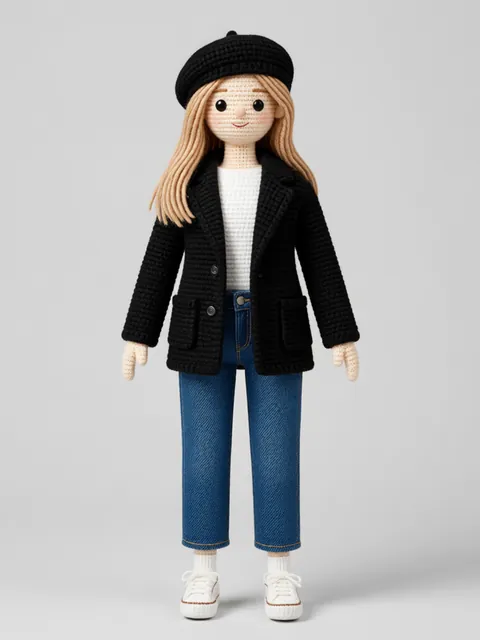
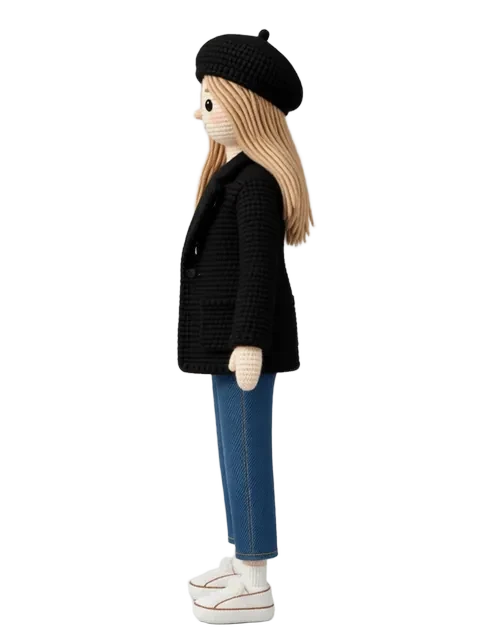
The workflow used by professional illustrators, animators, and game designers reverses the problem. Instead of trying to maintain consistency across many independent generations, you generate one consistent multi-angle reference set in a single pass, then use that set as the source of truth for every downstream image.
- Lock the design. Start with a single reference image. This can be hand-drawn, AI-generated, or a real photo. Quality of input determines quality of output — invest time here.
- Generate the multi-angle set. Use EZ Character's Turnaround Sheet tool. One upload produces 8 angles — front, three-quarter front, profile, three-quarter back, back, and the inverse. All eight share the same face, hair, body, and costume.
- Add expression and pose variations. From the same reference, generate expression sheets (happy, sad, surprised, angry, neutral) and pose libraries (standing, sitting, running, fighting). These extend the reference set, not replace it.
- Use the set for downstream work. For animation, the angles feed Live2D rigging or 3D base mesh sculpts. For comics, you reference the appropriate angle for each panel. For game sprites, the angles become the directional spritesheet. For children's books, every spread refers back to the canonical set.
How AI character consistency tools compare
| Tool | Approach | Consistency | Multi-angle output | Best for |
|---|---|---|---|---|
| EZ Character | Multi-angle generation in one pass | High | 8 angles per job | Production reference sheets, turnarounds, sprite sheets |
| Midjourney (--cref) | Reference-image weighting | Medium | One angle at a time | One-off stylized illustrations |
| Stable Diffusion + IP-Adapter | Image embeddings + ControlNet | Medium-High (with setup) | One angle at a time | Power users with technical setup |
| Stable Diffusion + LoRA training | Fine-tune on 20–40 character images | High (after training) | Requires re-prompting per angle | Long-running character work, recurring use |
| Runway / Kling / Higgsfield | Image-to-video motion synthesis | N/A — motion not identity | Video frames, not static refs | Animating an existing reference |
| DALL·E 3 / GPT-Image | Conversational refinement | Low–Medium | One image per prompt | Concept exploration, not production |
Common mistakes that destroy consistency
- Generating angles independently. Each independent generation reinterprets the character. Always generate the reference set in one pass.
- Vague reference descriptions. "Blue eyes" gives the model freedom you don't want. Specify shade ("ice blue, gray-blue"), shape ("almond, round"), and any unique features.
- Mixing styles across the set. Once you've locked an art style (line weight, shading approach, color palette), don't switch mid-set. Style change reads as identity change.
- Skipping the model sheet step. Going straight to scene illustrations without a reference set guarantees drift by spread 5.
- Over-relying on prompt engineering. Prompts describe; references anchor. The reference set is the anchor.
Frequently asked questions
What does AI character consistency mean?
Why is character consistency so hard in Midjourney, DALL·E, and Stable Diffusion?
What is the most reliable way to get consistent characters?
How many reference angles do I need for a children's book?
Does character consistency work for non-human characters (animals, monsters, robots)?
Can I use AI-generated character references for commercial work?
How is character consistency different from style consistency?
What tools do animators and game developers use for character consistency?
Generate your first consistent character set
Upload one image. Get 8 consistent angles. Use them as the source of truth for every downstream illustration, frame, or sprite.
Try Turnaround Sheet freeFree tier: 40 credits every month. No credit card required.